
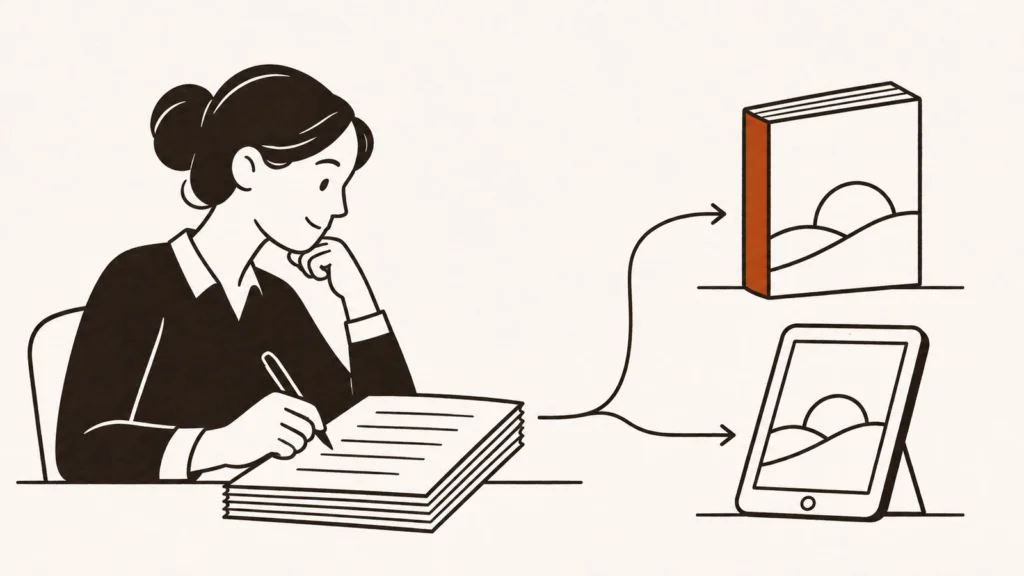
Self-publishing as an eSide hustle means writing a book and publishing it yourself as an ebook, a print book or an audiobook, without a traditional publisher. Online stores sell it, print services make copies on demand, and you keep a much bigger share of each sale than a traditional author would. You also take on the work a publisher would do.
See all 14 Self-Publishing listings
In this guide
- What self-publishing is
- How self-publishing works and how you get paid
- What self-publishing really pays
- The kinds of self-publishing platforms
- How to choose a platform
- Your first steps
- Costs, taxes and risks
- Red flags to watch for
- How to build your skills
- Recommended resources
- Owen’s take
- FAQ
1. What self-publishing is
A traditional publisher pays you an advance and royalties, and in return controls the editing, cover, price and distribution. Self-publishing reverses that. You decide everything and keep the rights, but you pay for editing and covers and do your own marketing.
Self-published books come in several formats:
- Ebooks sold on Kindle, Apple Books, Kobo, Google Play and other stores
- Paperbacks and hardcovers printed on demand when someone orders
- Audiobooks narrated by you, a hired narrator or digital voices
- Web serials published chapter by chapter, often free, to build readers
Fiction in popular genres, practical non-fiction and series sell especially well, but almost any book can find readers if it reaches the right people.
Who it suits
Self-publishing suits writers who want control and are willing to learn the business side: covers, descriptions, pricing and marketing. It’s slow to start and rewards authors who keep writing. Many successful self-published authors earn mostly from their backlist, not from a single book.
2. How self-publishing works and how you get paid
The path is similar whichever store you choose.
- Write and edit the book. A professional edit or proofread makes a real difference.
- Get a cover. Readers judge books by their covers, especially online.
- Format the files. Ebooks need a clean digital file; print books need an interior and full cover.
- Upload to stores or a distributor. Add the description, categories, keywords and price.
- Publish and promote. Launch to your readers, run promotions and gather reviews.
- Earn royalties. Stores pay a percentage of each sale, usually monthly with a delay.
Exclusive or wide. Some programmes, such as Amazon’s KDP Select, require your ebook to be sold only on Amazon in exchange for extra benefits. “Going wide” means selling on every store at once, either directly or through a distributor.
Print on demand. Print books are printed one at a time when ordered. You pay nothing upfront; the printing cost is deducted from each sale.
3. What self-publishing really pays
Royalty rates are higher than in traditional publishing, but sales vary hugely between books.
Amazon KDP offers two ebook royalty options, 35% and 70%. Since 7 July 2026, the 70% option on Amazon.com covers list prices from $2.99 to $12.99, up from a $9.99 ceiling that had been in place since 2007. Delivery costs are still deducted on the 70% option.
Print royalties on KDP changed in June 2025: paperbacks and hardcovers priced below $9.99 on Amazon.com now earn 50% instead of 60%, before printing costs. Books at $9.99 or more keep the 60% rate.
Other stores pay similar rates. Apple Books for Authors, Kobo Writing Life, Barnes & Noble Press and Google Play Books all list ebook royalties of around 70% in their programmes.
A few patterns hold:
- Series sell better than standalones. Readers who like book one buy the next.
- Price affects your rate. Ebooks priced outside a store’s royalty band can earn the lower rate.
- Print costs eat into margins. Long or colour books need higher prices to earn anything.
- Most books sell modestly. A few authors earn a lot; most earn small but steady amounts.
Royalties versus sales
A 70% royalty on a $4.99 ebook earns more per copy than a 60% royalty on a cheap paperback once printing is deducted. But some readers only buy print, and some only listen. Many authors publish in every format to reach all of them.
4. The kinds of self-publishing platforms
Amazon
- Kindle Direct Publishing for ebooks, paperbacks and hardcovers
Direct ebook stores
- Apple Books for Authors, with no exclusivity
- Kobo Writing Life for ebooks and audiobooks worldwide
- Barnes & Noble Press for Nook ebooks and BN.com print books
- Google Play Books for ebooks and audiobooks through Partner Center
Distributors
One upload, many stores.
- Draft2Digital for ebooks and print to Apple, Kobo, B&N, libraries and more
- BookBaby, which sells publishing packages and distributes without retail commission
Print on demand for bookstores
- IngramSpark, which lists your book with bookstores and libraries
- Lulu for books, journals and calendars, with its own bookstore
Audiobooks
- ACX for audiobooks on Audible, Amazon and Apple
- Voices by INaudio, formerly Findaway Voices, for dozens of stores and libraries
- Spotify for Authors for audiobooks on Spotify
Web serials
- Wattpad, which pays selected writers through Wattpad Originals
- Royal Road, a free platform where many authors build readers before publishing
5. How to choose a platform
Ask five questions first.
- Exclusive or wide? Amazon’s exclusive programme brings Kindle Unlimited readers; wide reaches every store.
- Which formats? Ebook, print, audio or all three.
- Direct or distributor? Direct accounts can pay more; distributors save time.
- Where are your readers? Some genres sell mostly on Amazon; others do well on Apple, Kobo or in libraries.
- What does each format cost? Print and audio need upfront work or money.
Many new authors start with KDP for the first book, then test going wide once they have a series.
6. Your first steps
- Choose a genre or topic readers already buy. Look at best sellers in your category.
- Finish the manuscript. Then revise it, with help from beta readers.
- Pay for editing. At least a proofread; developmental editing if you can.
- Get a professional cover. It’s the biggest single factor in whether readers click.
- Write a strong description. Hook, stakes and genre signals in the first lines.
- Publish the ebook and paperback. Set categories and keywords carefully.
- Start an email list. Readers who sign up are your best launch audience for the next book.
Building a backlist
One book rarely earns much on its own. Each new book promotes the others, especially in a series. Plan more than one title from the start, and keep writing while the first one finds its readers.
Getting your first reviews
Reviews help readers decide. Ask your email list, offer advance copies to readers in your genre and never buy reviews: stores remove them and can close accounts.
Pricing your first book
Look at what similar books in your genre sell for on each store, and price within that range. For ebooks, stay inside the store’s higher royalty band where you can. For print, check the printing cost first, then set a price that leaves a margin. Launch discounts can help early sales, but don’t underprice so far that readers assume the book is low quality.
7. Costs, taxes and risks
Upfront costs. Editing, covers, formatting and audiobook narration can cost hundreds or thousands.
Marketing costs. Ads and promotions help but can lose money without testing.
Royalty changes. Stores change rates and rules, as KDP’s 2025 and 2026 changes show.
Piracy. Books get copied. Stores have takedown processes, but you can’t stop it entirely.
Exclusivity trade-offs. Exclusive programmes can lift income on one store and limit it elsewhere.
Taxes. Book royalties are usually self-employment income. In the US, self-employment tax is 15.3% on top of income tax. Stores outside your country may ask for tax forms.
8. Red flags to watch for
- Vanity publishers. Companies that charge high fees and promise bookstore success.
- Paying for reviews. It breaks store rules and can get your book removed.
- Packages full of extras you don’t need. Compare costs line by line.
- Contracts that take your rights. Self-publishing should leave rights with you.
- Courses promising passive income from low-content books. Stores restrict them and readers rarely buy them.
9. How to build your skills
- Read widely in your genre. Learn what readers expect.
- Learn self-editing. Structure, pace and clear prose.
- Learn book marketing. Descriptions, keywords, categories and email lists.
- Learn basic ads. Amazon and social ads, starting small.
- Learn from other authors. Communities share what works on each store.
10. Recommended resources
These are listed in our Resources section.
- Kindle Publishing Income for guidance on earning from Kindle books
- Proofread Anywhere for training in proofreading
- Riverside for recording audiobook narration at home
- Coursera for courses in creative writing and publishing
11. Owen’s take
Self-publishing is the closest thing to owning a small media business with one person. The authors I see doing well write in a clear genre, publish regularly, build an email list and treat each book as part of a catalogue. Don’t skimp on the cover or the edit, and don’t expect the first book to pay the bills. The fifth one might, with the first four selling alongside it.
FAQ
How much do self-published authors earn per book?
It depends on price, format and store. KDP pays 35% or 70% on ebooks, and 50% or 60% on print before printing costs.
What changed on KDP in 2026?
From 7 July 2026, the 70% ebook royalty on Amazon.com covers list prices from $2.99 to $12.99.
Should I publish only on Amazon?
It depends on your genre and readers. Exclusivity brings Kindle Unlimited; going wide reaches other stores and libraries.
Do I need an ISBN?
Some stores provide free identifiers; others require your own ISBN, especially for print and wide distribution.
How much does it cost to self-publish a book?
Uploading is usually free. Editing, covers and narration are the main costs.
Sources
- Amazon KDP, “70% royalty option price band changes FAQ”: https://kdp.amazon.com/help?topicId=G200634560
- Built&Written, “Amazon changed book pricing rules in 2026”: https://www.builtwritten.com/blog/amazon-changed-book-pricing-rules-2026
- Internal Revenue Service, “Self-employment tax (Social Security and Medicare taxes)”: https://www.irs.gov/businesses/small-businesses-self-employed/self-employment-tax-social-security-and-medicare-taxes
All 14 Self-Publishing listings
-
ACX: Audiobook Publishing for Audible
ACX, the Audiobook Creation Exchange, is Amazon’s platform for producing and selling audiobooks on Audible, Amazon…
-
Apple Books for Authors: Publish Directly to Apple’s Store
Apple Books for Authors is Apple’s programme for self-published writers. You can sell ebooks directly in…
-
Barnes & Noble Press: Self-Publishing for B&N Readers
Barnes & Noble Press is the self-publishing platform of the largest US bookstore chain. It sells…
-
BookBaby: Paid Self-Publishing Packages With No Royalty Cut
BookBaby is a self-publishing service that sells packages covering design, formatting, printing and distribution. You pay…
-
Draft2Digital: Wide Distribution for Self-Published Books
Draft2Digital (D2D) is a distributor that sends your ebook, and optionally a print edition, to many…
-
Google Play Books: Sell Ebooks and Audiobooks on Google Play
Google Play Books lets self-published authors sell ebooks and audiobooks directly in the Google Play store…
-
IngramSpark: Print-on-Demand With Bookstore Reach
IngramSpark is the self-publishing arm of Ingram Content Group, one of the largest book distributors in…
-
Kindle Direct Publishing: Self-Publish Your Book on Amazon
Kindle Direct Publishing, or KDP, is Amazon’s self-publishing platform. You upload your manuscript and cover, set…
-
Kobo Writing Life: Direct Publishing to Kobo
Kobo Writing Life (KWL) is Rakuten Kobo’s free self-publishing platform. It puts your ebooks and audiobooks…
-
Lulu: Print-on-Demand With Unusual Formats
Lulu is one of the oldest self-publishing platforms, launched in 2002. It prints books on demand…
-
Royal Road: Build Readers With a Web Serial, Earn Off-Platform
Royal Road is a free platform for web serials, best known for fantasy, LitRPG and progression…
-
Spotify for Authors: Sell and Stream Your Audiobook on Spotify
Spotify for Authors is Spotify’s own platform for publishing audiobooks. Since August 2025, self-published authors can…
-
Voices by INaudio: Wide Audiobook Distribution Without Exclusivity
Voices by INaudio distributes audiobooks to retailers, subscription services and libraries from a single upload. It…
-
Wattpad: Earn From Serialized Fiction Through Wattpad Originals
Wattpad is a large platform where writers publish stories chapter by chapter and readers comment and…