
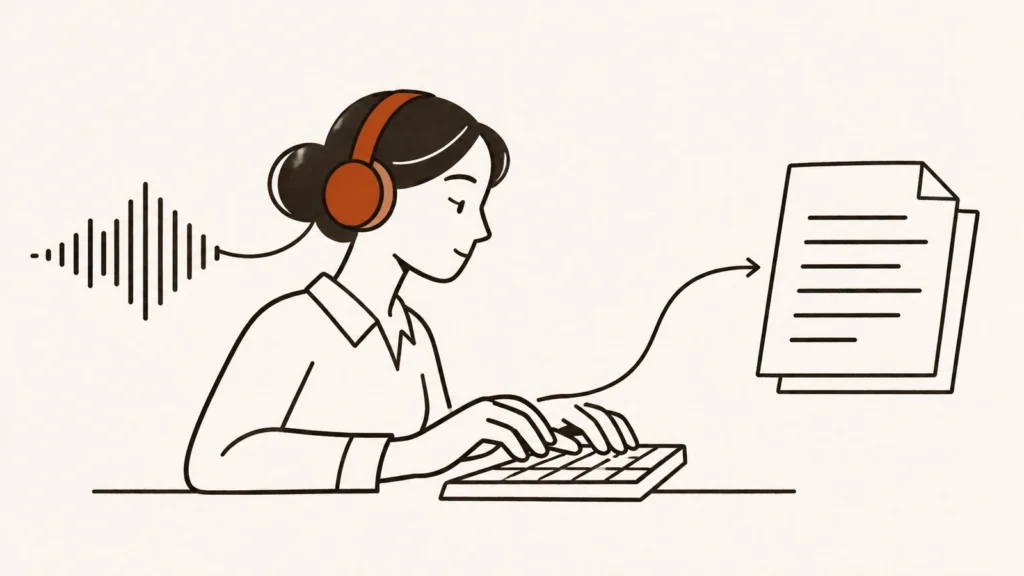
Transcription as an eSide hustle means listening to audio or video and turning it into accurate written text. Businesses, researchers, courts, schools and media companies need transcripts and captions. Transcription companies split that work into tasks for freelancers and pay per audio minute, per word or per hour of audio.
See all 10 Transcribing listings
In this guide
- What transcription work is
- How transcription platforms work and how you get paid
- What transcription really pays
- The kinds of transcription platforms
- How to choose a platform
- Your first steps
- Costs, taxes and risks
- Red flags to watch for
- How to build your skills
- Recommended resources
- Owen’s take
- FAQ
1. What transcription work is
Every interview, meeting, podcast, lecture, court hearing and medical dictation is a potential transcript. Transcripts make audio searchable, accessible and usable as evidence or records.
The work now comes in several forms:
- General transcription of interviews, meetings, podcasts and focus groups
- Captioning and subtitling for video
- Legal transcription of hearings, depositions and legal recordings
- Medical transcription of doctors’ dictations and reports
- AI transcript editing, correcting machine-made transcripts rather than typing from scratch
- Foreign-language transcription and translation
How AI has changed the work
Speech recognition now produces first drafts of most transcripts. Much freelance work has shifted from typing everything to reviewing and correcting machine output. That makes accuracy, grammar, research skills and attention to detail more valuable than raw typing speed.
Who it suits
Transcription suits people with good hearing, strong spelling and grammar, fast and accurate typing, and the patience to replay difficult audio. It needs a quiet place to work and headphones, and it’s flexible enough to fit around other commitments.
2. How transcription platforms work and how you get paid
Most platforms follow the same path.
- You apply. Some platforms are open to many countries; others accept only certain residents.
- You take a test. Usually a style guide quiz and a short transcription graded for accuracy.
- You learn the style guide. Each company has its own rules for timestamps, speakers, filler words and formatting.
- You pick up tasks. Short clips or full files appear on a work dashboard.
- Your work is reviewed. Quality scores affect your level, pay rate and access to work.
- You get paid. Weekly or monthly, usually by PayPal or bank transfer.
Pay is usually per audio minute or audio hour. You’re paid for the length of the recording, not the time it takes you. A clear one-speaker recording may take a few times its length to transcribe; a noisy group discussion can take much longer.
Clean verbatim and full verbatim
Clean verbatim removes filler words, false starts and repetitions so the transcript reads smoothly. Full verbatim keeps every “um”, stutter and interruption, which matters for research, legal work and some media. Each platform tells you which style a file needs, and mixing them up is one of the most common reasons for low quality scores.
3. What transcription really pays
Pay depends on the platform, your level, the audio quality and the specialisation.
Medical transcriptionists, a specialised and mostly employed group, earned a median annual wage of $40,410 in May 2025, according to the Bureau of Labor Statistics. The BLS also projects employment in the occupation to decline 4% from 2025 to 2035, as speech recognition takes over more first drafts.
Entry-level freelance platforms pay much less per hour of your time. TranscribeMe, for example, pays beginners $15 per audio hour on short clips, and the time to complete an audio hour is usually several hours of work.
A few patterns hold:
- Specialised work pays more. Legal, medical and foreign-language transcription pay above general work.
- Levels raise pay. Many platforms pay more as your accuracy score and grade improve.
- Audio quality changes your hourly rate. Clear audio is much faster than noisy, accented or multi-speaker audio.
- Work volume varies. Some weeks have plenty of files; others have few.
Your effective hourly rate
Divide what a file pays by the real time it took you, including research and proofreading. Track this for a few weeks on each platform. It shows which platforms and file types are worth your time.
4. The kinds of transcription platforms
General transcription and captioning
- Rev, paying per audio minute for transcription, captions and subtitles
- GoTranscript, with work in 140 languages and weekly payouts
- TranscribeMe, with short clips suited to beginners
- CastingWords, where higher grades earn more per minute
AI transcript editing
- Verbit for editing AI-generated legal and educational transcripts
- 3Play Media for editing machine transcripts and captions
Professional and specialised work
- Ubiqus for corporate, legal, medical and foreign-language transcription
- SpeakWrite for experienced US and Canadian typists, paid per word
- Way With Words, a UK company with demanding tests
Training
- Transcribe Anywhere, courses in general and legal transcription with a free mini course
5. How to choose a platform
Ask five questions first.
- Do they accept people from your country? Many US-focused companies don’t.
- What’s the test like? Some are short; others are demanding and take hours.
- How is pay calculated? Per audio minute, per word or per hour of audio, and how levels change it.
- How much work is available? Read recent reviews from transcribers.
- How and when do they pay? Weekly or monthly, PayPal or bank, and any minimum.
Most transcribers join two or three platforms so they always have work to pick from.
Why tests matter so much
Many platforms let you take their test only once, or make you wait months before trying again. Read the full style guide first, take any practice quizzes and do the test when you have time to check every line. A careful first attempt is worth more than a fast one.
6. Your first steps
- Test your typing. Aim for speed and, more importantly, accuracy.
- Get good headphones. Closed-back headphones help you hear quiet speech.
- Install transcription tools. A foot pedal and playback software that slows audio help a lot.
- Study each style guide. Most failed tests come from ignoring the rules, not from typing errors.
- Apply to two or three platforms. Take tests carefully, in a quiet place.
- Start with clear files. Build your score before taking on difficult audio.
- Track your hourly rate. Focus on platforms that pay best for your time.
Handling difficult audio
Use slower playback, turn up the volume only within safe limits and replay hard sections a few times. Research unfamiliar names and terms online. Mark sections you truly can’t hear with the platform’s tag rather than guessing.
Moving into specialised work
Legal and medical transcription need training in terminology and formatting. Courses, practice files and certifications can open better-paid work, but check current demand first, as automation is changing both fields.
Building speed safely
Speed comes from practice, keyboard shortcuts and text expanders for common words, not from rushing. Set up a comfortable chair, a keyboard at the right height and a screen at eye level. Short breaks every hour protect your wrists and ears and keep your accuracy high.
7. Costs, taxes and risks
Equipment. Headphones, a foot pedal and sometimes software cost money upfront.
Health. Long hours of typing and listening can strain wrists, eyes and ears. Take breaks and keep volume safe.
Uneven work. Work availability changes with client demand and automation.
Confidentiality. Audio may be private. Follow every platform’s privacy rules.
Taxes. Transcription income is usually self-employment income. In the US, self-employment tax is 15.3% on top of income tax.
8. Red flags to watch for
- Companies that charge for “starter kits” or tests. Real platforms don’t charge to apply.
- Jobs paying very high rates for easy work. Often scams or fake checks.
- Requests to buy software from the “employer”. A common fake-job pattern.
- Clients who ask for work outside the platform. You lose payment protection.
- Unpaid “trial” files that are full real jobs. Short tests are normal; free full files aren’t.
9. How to build your skills
- Practise accuracy. Grammar, spelling and punctuation matter more than speed.
- Learn research skills. Look up names, places and technical terms quickly.
- Learn style guides. Clean verbatim, full verbatim and timestamp rules.
- Learn captioning rules. Line length, timing and reading speed.
- Learn a specialisation. Legal, medical or a second language.
10. Recommended resources
These are listed in our Resources section.
- Proofread Anywhere for proofreading skills that carry over to transcript editing
- Alison for free courses in typing, grammar and transcription basics
- Coursera for courses in medical terminology and language skills
11. Owen’s take
Transcription is honest, flexible work, but it’s changing fast. Pure typing jobs are shrinking as AI handles first drafts; editing, quality control and specialised work are where the steadier money is. If you’re starting now, focus on accuracy and research skills rather than speed, join a couple of platforms, and track your real hourly rate. If it stays low after a few months, use the skills as a stepping stone to proofreading or editing.
FAQ
Can beginners get transcription jobs?
Yes. Platforms such as TranscribeMe and GoTranscript accept beginners who pass their tests.
How much do medical transcriptionists earn?
The BLS put the median annual wage at $40,410 in May 2025.
Is transcription being replaced by AI?
Partly. Much work has shifted to editing AI transcripts, and the BLS projects medical transcription jobs to decline.
Do I need special equipment?
Good headphones are essential; a foot pedal and transcription software help.
How fast do I need to type?
Accuracy matters more than speed, but faster, accurate typists earn more per hour.
Sources
- US Bureau of Labor Statistics, “Medical Transcriptionists”, Occupational Outlook Handbook: https://www.bls.gov/ooh/healthcare/medical-transcriptionists.htm
- Internal Revenue Service, “Self-employment tax (Social Security and Medicare taxes)”: https://www.irs.gov/businesses/small-businesses-self-employed/self-employment-tax-social-security-and-medicare-taxes
All 10 Transcribing listings
-
3Play Media: Editing Transcripts and Captions
3Play Media is a Boston-based media accessibility company that provides captions, transcripts, audio description and localization.…
-
CastingWords: Pay That Rises With Your Grade
CastingWords is a long-running transcription service where freelancers pick jobs from a shared Workshop. Pay ranges…
-
GoTranscript: Global Transcription Work in Many Languages
GoTranscript is a transcription and translation company founded in 2005 that hires freelance transcribers and editors…
-
Rev: The Best-Known Transcription Platform
Rev is one of the largest transcription companies, and it hires freelancers as transcriptionists, captioners, subtitle…
-
SpeakWrite: Paid Per Word, Not Per Minute
SpeakWrite is a transcription service whose typists are based in the US and Canada and work…
-
Transcribe Anywhere: Learn Transcription and Go Freelance
Transcribe Anywhere is an online school that trains people to work from home as transcriptionists. It…
-
TranscribeMe: Bite-Size Transcription for Beginners
TranscribeMe breaks audio into short clips of a few minutes, so you can transcribe in spare…
-
Ubiqus: Transcription for Business Meetings and More
Ubiqus is a long-established language services company that hires freelance transcriptionists for corporate, legal, medical and…
-
Verbit: Editing AI Transcripts for Legal and Education Clients
Verbit is a transcription and captioning company that combines AI with human editors. Its freelance roles…
-
Way With Words: Selective, Higher-Quality Transcription Work
Way With Words is a UK-based transcription company in business since 2001, working with academic, business,…