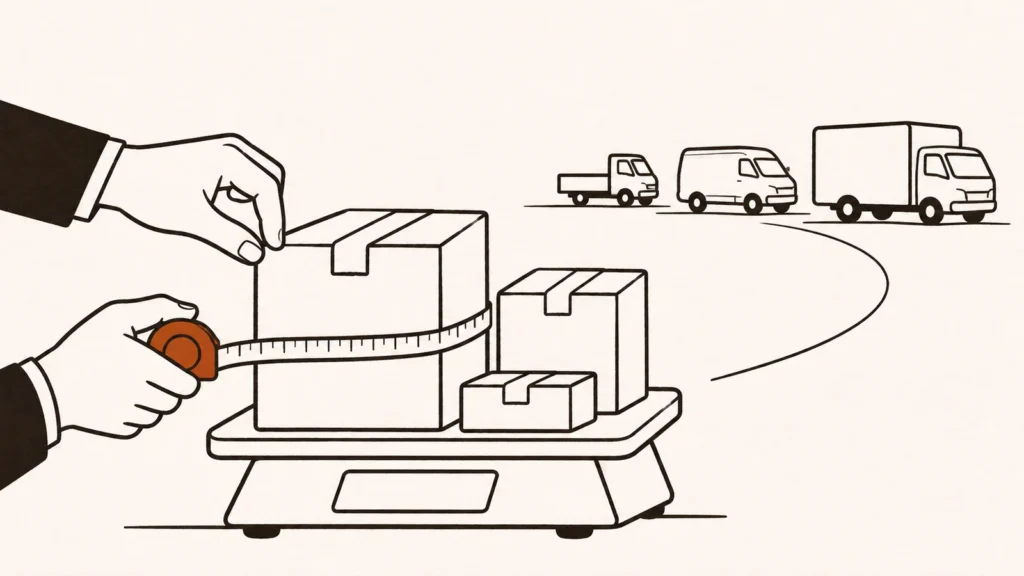
For small online sellers, USPS is often the cheapest option for light packages, especially with USPS Ground Advantage and discounted commercial rates through shipping software. UPS and FedEx often become more competitive for heavier packages, larger boxes and business deliveries, and when you qualify for negotiated rates. The only reliable answer is to compare real quotes for your own packages.
Shipping is one of the biggest costs for resellers and ecommerce sellers, and it changes every year. In 2026, all three carriers raised prices, and USPS changed how it measures and prices some packages. This guide explains how the carriers compare, what changed in 2026, how dimensional weight affects your costs and how to keep shipping from eating your margin.
In this guide
- What decides your shipping cost
- How the three carriers compare
- What changed in 2026
- Dimensional weight explained
- Choosing by package type
- Ways to cut shipping costs
- Owen’s take
- FAQ
1. What decides your shipping cost
Five factors set the price of almost every parcel:
- Weight. The actual weight, rounded up by the carrier’s rules.
- Size. Large, light boxes may be charged by dimensional weight instead of actual weight.
- Distance. Carriers price by zones, from local to cross-country.
- Speed. Ground services cost less than two-day or overnight services.
- Extras and surcharges. Residential delivery, remote areas, extra handling, fuel surcharges, signatures and insurance.
Where you buy the label matters too. Retail prices at a counter are usually higher than commercial prices available through carrier accounts and shipping software.
2. How the three carriers compare
| USPS | UPS | FedEx | |
|---|---|---|---|
| Strength | Light packages and residential delivery nationwide | Ground and business shipping, heavier parcels | Ground and express, heavier parcels |
| Key budget service | USPS Ground Advantage | UPS Ground | FedEx Ground and Home Delivery |
| Fast options | Priority Mail, Priority Mail Express | Air services | Express services |
| Residential surcharge | Generally not charged separately | Yes | Yes |
| Free pickup | Yes, scheduled | Varies by account | Varies by account |
| Best for | Small, light items such as clothing, accessories, books | Heavier or bulky goods, business shipments | Heavier or bulky goods, express delivery |
These are tendencies, not rules. Your rates depend on your weights, zones and any discounts you have.
3. What changed in 2026
UPS and FedEx
Both carriers announced 2026 general rate increases averaging 5.9%. UPS’s took effect on December 22, 2025, and FedEx’s on January 5, 2026. “Average” is the key word: actual increases vary by service, weight and zone, and surcharges also changed.
USPS
USPS made several changes in 2026:
- January 18, 2026. Annual shipping price increases, averaging 7.8% for Ground Advantage, 6.6% for Priority Mail, 5.1% for Priority Mail Express and 6.0% for Parcel Select, according to Pitney Bowes’ summary of the USPS filing.
- April 2026. A temporary price adjustment added 8% to base postage for Priority Mail Express, Priority Mail, Ground Advantage and Parcel Select, to reflect rising transportation costs.
- July 12, 2026. USPS ended ounce-based price differences for published commercial Ground Advantage prices, so packages under a pound are charged the same within a zone regardless of their exact weight in ounces. Retail Ground Advantage prices stayed the same. Customers with negotiated commercial rates were not affected by the ounce change.
- Dimensional weight. From July 12, 2026, USPS changed its dimensional weight divisor from 166 to 139 and began rounding package dimensions up to the next whole inch for these calculations, which raises the billable weight of some larger, light packages.
If you sell light items, review your rates after these changes. Packages that were cheap at 4 or 8 ounces under commercial pricing may now cost the same as a package just under a pound.
4. Dimensional weight explained
Dimensional (DIM) weight charges for the space a package takes up, not just how heavy it is. The carrier multiplies length by width by height, divides by a number called the divisor, and charges whichever is higher: the DIM weight or the actual weight.
A lower divisor produces a higher DIM weight. That’s why USPS’s change from 166 to 139 matters for sellers who ship light but bulky items, such as pillows, lampshades or soft toys.
How to reduce DIM charges:
- Use the smallest box that protects the item.
- Switch to poly mailers for soft goods like clothing.
- Measure accurately and remember carriers may round dimensions up.
- Compare carriers for bulky items, since each applies its own DIM rules.
5. Choosing by package type
- Under a pound, small and flat. USPS Ground Advantage is often the cheapest, especially with commercial rates. Check cubic and soft pack pricing in your shipping software.
- One to five pounds. Compare USPS Ground Advantage, Priority Mail flat rate options and UPS or FedEx ground services. Distance makes a big difference.
- Heavy items. UPS and FedEx ground services often compete well, especially with negotiated discounts.
- Large, light boxes. Check DIM weight for each carrier before choosing.
- Urgent delivery. Compare USPS Priority Mail Express with UPS and FedEx express services for the specific destination.
- Business addresses. UPS and FedEx are well suited, and residential surcharges don’t apply.
6. Ways to cut shipping costs
- Use shipping software. Platforms that sell discounted commercial labels and compare carriers side by side can save money over retail counter prices.
- Use marketplace labels. Etsy, eBay and other marketplaces offer discounted labels to their sellers.
- Weigh and measure every product. Know exact weights and box sizes before setting prices.
- Right-size your packaging. Smaller boxes and mailers reduce DIM charges.
- Use flat rate options when they win. Heavy, compact items can be cheaper in a flat rate box.
- Build shipping into your prices. Free shipping isn’t free; it moves the cost into your product price.
- Review rates after every change. Carriers change prices and rules several times a year.
- Ask about discounts as you grow. Once you ship regularly, carriers and shipping platforms may offer better rates.
You can compare marketplaces and store builders in our Ecommerce directory and reselling platforms in Reselling. See also our guides to ecommerce platforms for beginners and Etsy vs Amazon Handmade.
7. Owen’s take
There’s no single cheapest carrier. For most small sellers, USPS wins on light packages and UPS or FedEx become competitive as packages get heavier. The bigger savings usually come from how you ship: discounted labels through software or marketplaces, smaller packaging and prices that include real shipping costs. And after 2026’s changes, I’d recheck rates on every product, especially light items and bulky boxes.
FAQ
Which is cheapest: UPS, USPS or FedEx?
It depends on weight, size, distance and discounts. USPS is often cheapest for light packages; UPS and FedEx are often competitive for heavier parcels.
Did shipping prices go up in 2026?
Yes. UPS and FedEx announced average increases of 5.9%, and USPS raised prices in January, added a temporary increase in April and changed how it prices some packages in July.
What is dimensional weight?
A way of charging for package size as well as weight. Carriers charge the higher of DIM weight and actual weight.
How can small sellers get cheaper shipping?
Use shipping software or marketplace labels for commercial rates, right-size packaging and compare carriers for each package type.
This guide is part of our Ecommerce section, with every platform we have checked in that area.
Sources
- Federal Register, “Competitive Price Changes” (USPS, May 15, 2026): https://www.govinfo.gov/content/pkg/FR-2026-05-15/html/2026-09785.htm
- Pitney Bowes, “USPS shipping and mailing price changes”: https://www.pitneybowes.com/us/postal-information/usps-rate-change-overview.html.html
- Ordoro, “USPS shipping changes 2026”: https://blog.ordoro.com/2026/07/16/usps-shipping-changes-2026/